Influencer marketing isn't a side experiment anymore. It's become one of the main ways brands find new customers. Global spending hit roughly $32.5 billion in 2025 and is on track to pass $40 billion in 2026 — a market that has tripled in just five years. On average, brands earn close to $5.78 for every dollar spent on influencer campaigns, and 86% of US marketers now work with creators in some way. These numbers explain why influencer programs keep growing. They don't explain how brands are supposed to manage all of it once it does.
Here's what usually happens as a creator program grows: the spreadsheet that worked fine for five influencers starts falling apart at fifteen. WhatsApp chats pile up. Someone forgets which creator already received their product. When finance asks for ROI numbers, the honest answer is "we're not totally sure." This isn't the team's fault — it's simply what happens when a channel grows faster than the tools built to manage it.
That's exactly the problem AI-powered influencer marketing software is designed to solve. As campaigns grow, managing creators through spreadsheets, emails, and endless message threads quickly becomes difficult. Finding the right creators, keeping track of conversations, reviewing content, and measuring results can easily slow a team down. Instead of juggling multiple tools, brands can manage everything from one place while AI takes care of time-consuming tasks like creator recommendations, outreach, and campaign insights. This gives marketing teams more time to focus on building stronger creator partnerships and running campaigns that actually deliver results.
What Is AI-Powered Influencer Marketing Software?
Influencer marketing software brings creator relationships and campaigns into one system, instead of scattered emails, DMs, and spreadsheets. It usually covers creator search, outreach, tracking deliverables, content approval, and reporting.
What makes the AI-powered version different isn't one flashy feature — it's how much of the thinking gets automated. A regular platform lets you filter creators by follower count and location. An AI-driven one looks at engagement patterns, audience quality, and content style to suggest creators who are actually likely to do well for your specific campaign. It can also catch warning signs — like a sudden spike in followers that usually means bought followers — much faster than a person scrolling through profiles one by one.
The real difference is speed. Doing this manually means hours spent comparing profiles, writing outreach messages one at a time, and pulling together performance numbers by hand at the end of a campaign. AI turns that into minutes: creator shortlists build themselves, outreach messages go out without anyone drafting them, and dashboards update in real time.
This shift is happening quickly, and for good reason. More than 85% of marketing teams now use generative AI in some part of their work, up from roughly half just two years ago. Teams using AI report real-time savings each week, which they put back into strategy instead of manual tasks. Influencer marketing — with its heavy load of repetitive research and outreach — is one of the first places this shift shows up.
Manual Influencer Marketing vs AI-Powered Influencer Marketing Software
As influencer campaigns grow, manual processes become harder to manage and more prone to errors. AI-powered influencer marketing software replaces repetitive tasks with intelligent automation, enabling brands to scale campaigns faster while improving efficiency and decision-making.
| Manual Influencer Marketing | AI-Powered Influencer Marketing Software |
|---|---|
| Creator search through manual research | AI-powered creator recommendations based on campaign goals |
| Outreach via emails, DMs, and spreadsheets | Automated outreach and follow-ups |
| Campaigns managed across multiple tools | End-to-end campaign management from one platform |
| Manual competitor research | AI-driven competitive intelligence and campaign insights |
| Spreadsheets for tracking creators and deliverables | Real-time dashboards with live campaign tracking |
| Manual reporting and ROI calculations | Automated performance analytics and ROI measurement |
| Separate tools for payments and approvals | Centralized content approvals and creator payouts |
| Difficult to scale multiple campaign types | Easily manage paid, barter, affiliate, UGC, and product seeding campaigns |
Why This Matters
Modern influencer marketing isn't just about finding creators—it's about managing relationships, workflows, approvals, payments, and performance at scale. AI-powered influencer marketing software eliminates manual bottlenecks, helping brands launch campaigns faster, optimize creator partnerships, and make data-driven decisions with confidence.
Why Manual Influencer Marketing Workflows Hold Brand Collaborations Back
Most brands don't set out to build a messy influencer workflow. It happens slowly, one creator relationship at a time, until the cracks are impossible to ignore.
- Spreadsheets track names, not history. No engagement data, no notes from past collaborations, no contract status — just whatever someone last remembered to type in.
- Manual research means judging creators by eye. Follower counts alone don't tell you if an audience is real, engaged, or even in the right location.
- Email and DM follow-ups eat up hours that should go toward strategy. A coordinator managing twenty creators can lose most of a week just chasing replies.
- Tracking deliverables gets messy fast once barter, paid, UGC, and affiliate campaigns run at the same time, each with its own format, deadline, and approval steps.
- ROI across platforms — Instagram here, TikTok there, Shopify somewhere else — usually gets reduced to likes and comments, because tracking real sales by hand takes too long.
- Affiliate tracking without software often depends on creators self-reporting their own sales, which isn't accurate or reliable.
- Reporting delays follow naturally. By the time a report is ready, its lessons are already too late to help the next campaign.
- Duplicate work happens when team members research the same creators without knowing it — wasted time, and sometimes two people reaching out with different offers.
- Poor visibility across marketing, creative, and finance slows everything down, since no one is looking at the same version of what's actually happening.
None of these problems feels huge on its own. Together, they're exactly why brands running serious creator programs eventually look for software that brings everything into one place.
Meet MyWall: An AI-Powered Influencer Marketing Platform
As influencer marketing programs grow, choosing the right influencer marketing software becomes essential for managing creator discovery, outreach, campaign execution, performance tracking, and ROI from one centralized platform. MyWall brings all of these capabilities together with AI-powered automation, helping brands execute smarter, data-driven campaigns at scale.
MyWall was built on a simple idea: brands don't need five different tools stitched together. They need one platform that connects creator discovery, relationship management, campaign execution, and performance tracking into a single workflow.
Instead of treating AI as an extra feature, MyWall builds it into the whole platform — suggesting creators, automating outreach, and surfacing competitive insights that would otherwise take hours to dig up manually. Brands can run barter, paid, UGC, and affiliate campaigns from the same account, which matters because most active creator programs aren't running just one type of campaign — they're running several at once, often with the same creators and budgets.
This setup also means teams don't have to choose between control and speed. Brands can run private, invite-only campaigns for close-knit partnerships, or list campaigns publicly through the MyWall Creator App and let interested creators apply directly — sometimes doing both at once, depending on what the campaign needs. That's a level of flexibility a single-purpose discovery tool or a basic CRM simply can't offer.
Features That Make MyWall Different
1. Creator Discovery Platform
Finding the right creator isn't about finding the biggest one — it's about finding the one whose audience actually matches your customers. MyWall's discovery tools search across 300M+ profiles on Instagram, TikTok, and YouTube.
Brands can filter and evaluate creators by:
- Location and niche — down to city, state, and sub-niche, not just broad categories
- Audience size and engagement rate — so reach and real interaction are both part of the decision
- Verified, live performance data — actual metrics instead of self-reported follower counts
- Audience quality signals — visual score and engagement score to catch inflated or inactive followings
- Past brand collaborations — seeing who a creator has already worked with, and how that content performed
Together, this helps brands avoid a common mistake: working with a creator who looks great on paper but whose audience doesn't actually buy anything. AI-driven suggestions also surface creators who fit a campaign's goals, even ones a marketer might never have thought to search for by name.
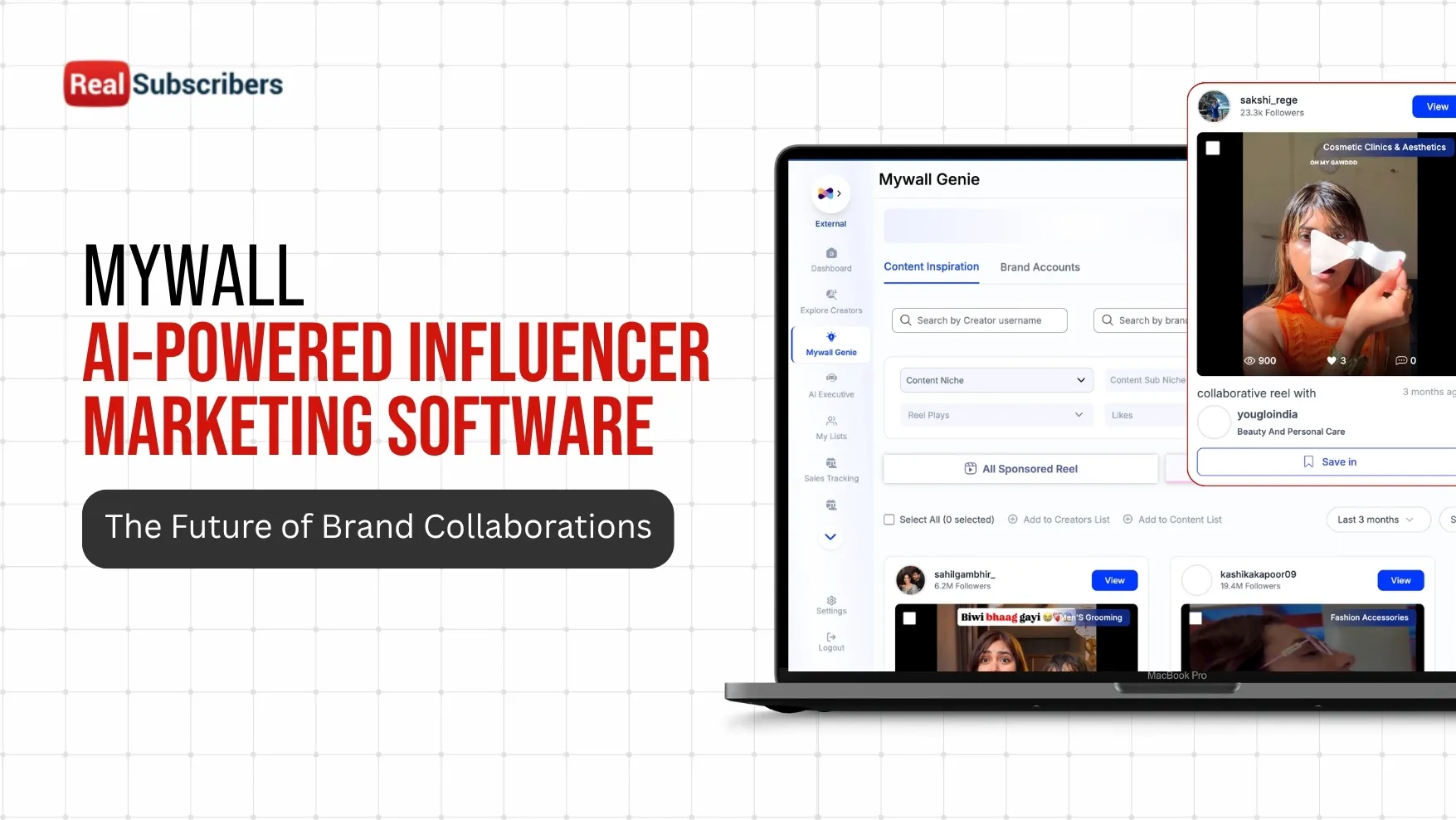
2. MyWall Genie — AI Competitive Intelligence Engine
Most influencer platforms help you find creators. MyWall Genie helps you understand what's already working for everyone else before you spend a single dollar.
Genie lets brands look directly at competitor campaigns — searching by niche, hashtags, captions, or company name to see which creators a competitor has worked with and how well those partnerships actually performed. Instead of guessing which content direction to take, a team can study which formats, hooks, and creator types are already driving engagement in their category, and use that as a starting point.
With Genie, brands can:
- See who competitors are working with — search by niche, sub-niche, hashtags, or company name to find exactly which creators a rival brand has partnered with
- Study what's actually performing — review collaborative, sponsored, and affiliate content side by side to see which formats and hooks are driving results
- Spot category trends early — track how creators and audience size are distributed across a niche, so strategy is based on data instead of a hunch
- Validate creators before reaching out — check a creator's track record with other brands before committing budget to them
This matters because influencer decisions are often made on gut feeling — a brand picks a creator. After all, they "seem like a good fit," without much proof either way. Genie replaces that guesswork with real data: engagement trends by niche, where competing brands are spending, and what content is actually working before any money changes hands.
3. AI Executives — Campaigns on Autopilot
AI Executives take on the day-to-day work that usually falls on a coordinator. From a single prompt, the system can set up a campaign, suggest a matching list of creators, start outreach, follow up automatically, and keep everything moving without someone pushing each step forward by hand.
Here's what AI Executives take off a team's plate:
- Campaign setup — turning a single prompt into a fully structured campaign, ready to launch
- Creator shortlisting — matching creators to a campaign's goals automatically, instead of manual searching
- Outreach and follow-ups — sending initial messages and chasing non-responses without anyone drafting each one
- Workflow tracking — keeping every campaign's status current so nothing slips through the cracks
- Reporting — pulling performance data together as the campaign runs, not just at the end
This doesn't mean campaigns run with zero human input. It means the repetitive parts — writing outreach messages, chasing people who haven't replied, updating status — happen on their own, while the team focuses on approvals and bigger decisions. For a brand running several campaigns at once, that adds up fast: less time spent on busywork, more time spent deciding which creators and content are actually worth the investment.
4. Influencer CRM
Creator relationships that matter usually last longer than one campaign, and MyWall's CRM is built with that in mind. Brands can track conversation history, save notes from past collaborations, and see a creator's full track record in one place, instead of digging through old email threads.
The CRM keeps track of:
- Conversation history — every message and negotiation with a creator, in one thread
- Collaboration notes — details worth remembering for next time, like reliability or content quality
- Full engagement history — every past campaign a creator has been part of, and how it went
- Creator pipelines — organizing prospects, active partners, and past collaborators separately, so nothing gets lost
That history matters in practice. A creator who delivered great results six months ago is worth prioritizing again — but only if someone actually remembers that. Keeping this history in one place turns one-off partnerships into a pool of creators a brand can keep coming back to, instead of starting the search from scratch every time. It also means a new team member doesn't have to lose months of relationship history when they take over — the record stays with the platform, not one person's inbox.
5. Campaign Management
Once a campaign goes live, MyWall handles the day-to-day: assigning deliverables, tracking content approvals, watching timelines, and managing payments. Everything from a barter product shipment to a paid post's approval status lives in the same dashboard, which is what actually makes it possible to report across every campaign at once, not just in theory.
Campaign management covers:
- Deliverable tracking — knowing exactly what each creator owes and by when
- Content approvals — reviewing and signing off on posts before they go live, all inside the platform
- Affiliate tracking — real-time sales and commission data, instead of numbers creators report themselves
- Payments — wallet-based payouts that replace one-invoice-at-a-time reimbursement
- Sales-linked analytics — connecting campaign activity directly to revenue through built-in Shopify, WooCommerce, and Magento integrations
This is also where analytics tie everything together. Instead of pulling engagement numbers from each platform separately, MyWall connects campaign activity straight to sales data, so a brand can see not just how many people viewed a piece of content, but how many of those views turned into clicks, and how many of those clicks turned into actual sales. For teams that have only ever reported on likes and comments because tracking real sales by hand took too long, that change alone shifts the whole conversation with finance.
Payments follow the same idea. Instead of handling creator payouts one invoice at a time, MyWall's wallet system brings them all together, giving both the brand and the creator a clear, fast, and easy-to-follow record of what's owed and what's been paid. It's one more manual task taken off a very full plate.
Conclusion
Influencer marketing isn't getting any simpler. More campaign types, more platforms, more creators, and more pressure to prove real ROI instead of just good vibes. That growing complexity is exactly why the channel is becoming more data-driven and more AI-assisted, not less. Teams that lean on automation for discovery, outreach, and reporting can simply run more campaigns with better information in less time than teams that still do everything by hand.
Finding good creators has never really been the hardest part of influencer marketing. Connecting discovery, outreach, relationship management, execution, and competitive intelligence into one working system is. That's the problem MyWall is built to solve. If your team is still piecing together spreadsheets, email threads, and disconnected reports to run what should be one smooth workflow, it's worth seeing what a platform built to do all of it — with AI doing the heavy lifting — actually looks like in practice.