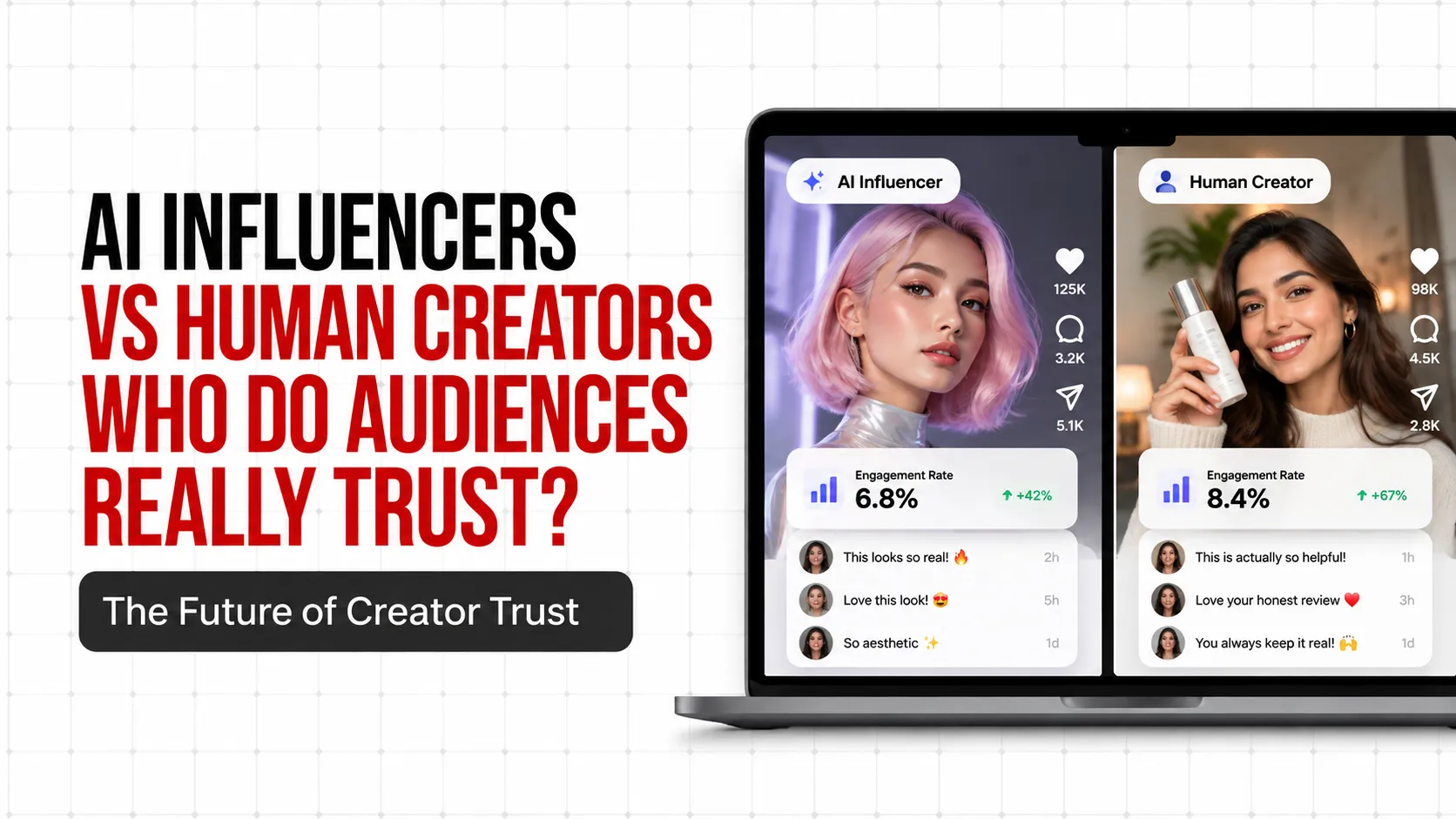
A virtual influencer never misses a posting deadline, never ages and never gets caught in a controversy. On paper, it is the perfect brand ambassador. Yet many brands are quietly stepping back from them.
The reason comes down to trust. AI influencers can win attention, especially in markets like India, but attention is only the first step. When a shopper is deciding whether to spend ₹40,000 on a laptop or try a new skincare product, that shopper wants to hear from someone who has actually used it.
This article looks at what the research says about how audiences respond to AI influencers compared with human creators, why India stands out, what disclosure rules require, and how brands decide which one to use.
Key Takeaways
- India was the most open of the 17 markets YouGov surveyed: 55% of Indians said they were likely to interact with AI-generated influencer content, against a 23% global average (YouGov, December 2024 survey).
- Openness is not trust. A 2025 peer-reviewed study found that AI endorsers lead consumers to see brands as less trustworthy and to be less likely to buy (Zhang & He, Journal of Product & Brand Management).
- In a 2025 experiment, ads labelled as AI-made earned less trust and purchase intent, especially for high-involvement products. Influencer posts were not tested, but India's advertising code requires virtual influencers to disclose they are not human, so brands face a similar risk.
- Brands are pulling back: the share willing to use AI creators fell from 86% to 60% in under a year, according to Collabstr data reported by Digiday.
- The emerging consensus: human creators where trust drives the sale, AI for scale, production and low-stakes creative.
- 1. What Are AI Influencers, and How Are They Different From Human Creators?
- 2. Do Audiences Trust AI Influencers? What the Data Says
- 3. Why High Engagement With AI Influencers Can Be Misleading
- 4. The Disclosure Dilemma: Labelling AI Content Lowers Trust, but Rules Require It
- 5. AI Influencers vs Human Creators: Side-by-Side Comparison
- 6. Are Brands Moving Toward or Away From AI Influencers?
- 7. When Do Brands Use AI Influencers, Human Creators or Both?
- 8. What This Means for Creators
- 9. Frequently Asked Questions
- 10. Conclusion: Trust Still Has a Human Face
What Are AI Influencers, and How Are They Different From Human Creators?
AI influencers, also called virtual influencers, are computer-generated personas that post on social media as if they were real people. A brand or studio controls everything they say, wear and promote. Human creators are real people who share their own experiences, and their audiences follow them because of who they are.
Between the two sits a growing middle ground. Many human creators now use AI tools to script, edit, translate or create variations of their content, while still appearing on camera and speaking from their own experience. Some creators have also licensed "digital twins" of themselves.
Three types are worth separating:
| Type | Who is on screen | Who controls the message | Example use |
|---|---|---|---|
| Human creator | A real person | The creator, guided by a brief | Product reviews, tutorials, day-in-the-life content |
| AI-assisted creator | A real person | The creator, with AI tools for production | Faster editing, multilingual versions, script drafts |
| Fully virtual influencer | A computer-generated persona | The brand or studio | Fashion visuals, mascots, gaming and entertainment |
Lil Miquela, one of the best-known virtual influencers, had close to 2.5 million Instagram followers in September 2025, but had lost about 142,000 over the previous year, according to CreatorDB data reported by Digiday. Novelty alone does not appear to hold an audience.
Do Audiences Trust AI Influencers? What the Data Says
Audiences will engage with AI influencers, especially in India, but a 2025 controlled study found that AI endorsers make brands seem less trustworthy than human creators do. The two findings only look contradictory until "would watch" is separated from "would believe".
Willingness to engage varies hugely by country
YouGov surveyed adults in 17 markets in December 2024 and asked whether they were likely to interact with AI-generated influencers. India came out on top at 55%, followed by the UAE (51%) and Indonesia (48%). The global average was 23%, and the US, UK and Denmark were lowest at 11% each. YouGov published the results in June 2025, with 501 to 2,003 adults surveyed per market (YouGov).
Indians are five times more likely than Americans or Britons to say they would interact with AI influencers. Source: YouGov, 2025.
But AI endorsers lower trust in the brand
In two scenario experiments published in 2025, researchers Yu Zhang and Ai-Zhong He compared AI and human influencers. When an AI influencer endorsed a brand, consumers saw the brand as less trustworthy, and that lowered their purchase intention (Journal of Product & Brand Management). The researchers explain this through "agency": people sense that an AI persona cannot really have chosen, tried or judged the product.
Trust in human influencers is not automatic either. In BBB National Programs' 2025 Influencer Trust Index, 74% of more than 3,700 US consumers said they trust influencer content at least somewhat, but only 5% trust it completely (BBB National Programs, June 2025). Human creators earn trust slowly. A persona that has never used the product starts further behind.
Why High Engagement With AI Influencers Can Be Misleading
India's enthusiasm for AI is real, but no published data yet shows it turning into purchases from AI influencers. That makes AI influencer campaigns easy to over-read.
YouGov's data shows Indians are among the more optimistic markets about AI, while globally more people feel cautious (22%) or concerned (17%) than optimistic (16%) or excited (7%). A young, mobile-first audience that enjoys new formats will happily watch and comment on a virtual persona.
This mirrors a familiar problem with very large human accounts: big numbers on the dashboard, few orders. Agencies such as Grynow have written about why high follower counts often fail to deliver sales, and the same gap between reach and conversion applies to virtual personas.
The Disclosure Dilemma: Labelling AI Content Lowers Trust, but Rules Require It
Early research on ads suggests that telling people content was made by AI lowers trust and purchase intent. In India, brands cannot skip the label, because the Advertising Standards Council of India (ASCI) requires virtual influencers to disclose that they are not real people.
What the research shows
A 2025 experiment tested advertisements that were either AI-generated or human-made, and labelled as one or the other. Ads labelled as human-made earned more trust and purchase intent, even when AI had actually made them. Ads transparently labelled as AI-generated "caused lower trust and intent, particularly for high-involvement products" such as laptops, compared with low-involvement products such as snacks (Israfilzade, Equilibrium 2025, ). The study tested ads, not influencer posts, so it is a warning rather than proof. If the pattern holds for creators, the more considered the purchase, the bigger the penalty for an AI label.
What the rules say
- India (ASCI): influencer advertising guidelines require virtual influencers to disclose to consumers that they are not interacting with a real human being, on top of the usual ad label for paid content (ASCI guidelines). Every disclosure must be clear and upfront.
- Instagram and Facebook: Meta adds an "AI info" label to content it detects as AI-generated or that people disclose as AI-generated when they upload it (Meta).
Why hiding it is not an option
Skipping the label to protect trust backfires. In the BBB Trust Index, 70% of consumers said they feel deceived when a brand partnership is not disclosed. For AI personas, being found out later is worse than disclosing upfront, both legally and for the brand's reputation.
AI Influencers vs Human Creators: Side-by-Side Comparison
AI influencers win on control, availability and consistency. Human creators win on trust, credibility and real product experience. The table compares them on the factors that matter most in a campaign:
| Factor | Human creators | AI / virtual influencers |
|---|---|---|
| Audience trust | Higher; built through real experience and personality | Lower in a 2025 controlled study; AI labels also cut trust in ads |
| Product claims | Can credibly say "I used this for a month" | Cannot genuinely have used the product |
| Creative control | Shared with the creator | Total control by the brand |
| Availability and scale | Limited by people's time | Can post anytime, in any setting |
| Brand-safety risk | Creator's personal conduct | Backlash against AI use, "uncanny" content |
| Disclosure burden | Standard ad label | Ad label plus "not a real human" disclosure in India |
| Regional and cultural nuance | Native fluency in language, humour and local context | Has to be designed in, and can feel generic |
| Best-fit categories | Beauty, health, finance, food, parenting, electronics | Fashion visuals, gaming, entertainment, brand mascots |
Are Brands Moving Toward or Away From AI Influencers?
Brands are cooling on AI influencers, and trust is the reason they cite most. The share of brands willing to use AI creators fell from 86% in October 2024 to 60% in August 2025, according to Collabstr data reported by Digiday.
Brand willingness to use AI creators dropped 26 points in under a year. Source: Collabstr via Digiday, 2025.
The brand side explains why. In an April 2025 World Federation of Advertisers survey of 33 executives at 27 multinational brands, 60% of respondents had no plans to adopt virtual influencers, and according to Digiday, 96% of brands with no plans cite consumer trust issues as their reason for caution.
That does not mean AI influencers have no audience. In a May 2025 survey of 2,001 US Gen Z consumers by Whop, 40% said they follow a virtual influencer and 33% said they had made a purchase decision based on one (also reported by Digiday). There is a real audience for virtual personas, but it skews young, and this survey covered only US Gen Z.
When Do Brands Use AI Influencers, Human Creators or Both?
Brands increasingly use human creators wherever trust drives the purchase, AI influencers for low-stakes, high-volume or fantasy-led creative, and AI tools to make human creator content faster and cheaper to produce. For most brands, a hybrid approach works best.
Human creators for considered purchases
Finance, health, skincare, electronics and parenting all depend on a believable "I tried this" moment. These are the kind of high-involvement purchases where the ad study found AI labels hurt most. Smaller creators often carry the most trust here, because their followers treat their recommendations like advice from a friend. Agencies that specialise in micro-influencer campaigns build programmes around exactly this effect.
Language and culture add another layer that AI personas struggle with. In a country as diverse as India, regional-language creators bring local humour, references and credibility that a generic virtual persona rarely matches.
AI or virtual influencers for visual and playful products
Virtual personas can work for fashion lookbooks, gaming, entertainment, tech-forward brands and long-running brand mascots, where the audience knows the persona is fictional and enjoys it. Brands that use them well treat them as a creative format, disclose clearly, and measure them on sales rather than engagement.
A hybrid model for everything in between
The most practical option for many brands is human creators on camera, with AI behind the scenes. AI handles script drafts, editing, subtitles, regional-language versions and ad variations, while the creator stays the face and the voice.
What This Means for Creators
For human creators, the research is reassuring. The thing audiences value most, a real person's experience and judgement, is exactly what an AI persona cannot copy. AI tools can save creators hours on editing, captions and translations, but the parts that build trust still come from the creator: honest reviews, consistent disclosure and a recognisable voice.
The same data also carries a caution. Audiences only partly trust influencer content as it is, and disclosure failures damage that trust quickly. Creators who label sponsored and AI-assisted content clearly, and who recommend only what they have actually used, are the ones best placed to benefit as AI-generated content fills social feeds.
Frequently Asked Questions
Do people trust AI influencers?
Less than human creators. Many people, especially in India, are happy to watch and interact with AI influencer content: 55% of Indians said they were likely to, compared with 23% globally (YouGov). But experiments show AI endorsers make brands seem less trustworthy and reduce purchase intent (Zhang & He, 2025).
Are AI influencers cheaper than human creators?
Not always. A virtual influencer has no day rate and can post endlessly once it exists, but designing, rendering and running a convincing persona takes ongoing creative and technical work. With lower trust and extra disclosure factored in, the cost per sale may end up higher than working with well-chosen human creators.
Do AI influencers have to disclose they are not real?
In India, yes. ASCI's influencer guidelines require virtual influencers to tell consumers they are not interacting with a real human being, in addition to the usual label for paid content (ASCI guidelines). Platforms such as Instagram also label content identified as AI-generated.
Will AI influencers replace human creators?
Unlikely, at least in categories where trust drives the sale. Brand willingness to use AI creators has already fallen from 86% to 60%, and in a WFA survey, almost all brands with no plans to use them cited consumer trust. AI is far more likely to change how human creators produce content than to replace them.
Can brands use AI and human creators together?
Yes, and for most brands that is the most practical option. A real creator stays the face and voice, while AI handles scripting, editing, translations and ad variations. The brand gets the speed of AI with the trust of a real person.
Conclusion: Trust Still Has a Human Face
AI influencers are good at getting attention, and India is one of the most curious audiences for them. The research so far points one way: a 2025 study found AI endorsers lower brand trust, a separate ad experiment found AI labels hurt most for considered purchases, and in India virtual influencers must disclose they are not human. Brands have noticed, and many are pulling back.
The likely future is not a choice between the two but a division of labour: real creators in front of the audience wherever belief drives the sale, and AI doing the heavy lifting behind the camera. Brands that want to put this into practice often work with an influencer marketing agency that vets creators for audience fit and trust before a campaign begins.